
Table of Contents
- Introduction: The Geometric Complexity of Global Corporate Accounting
- Architectural Hierarchy: Transaction, Base, and Reporting Currencies
- Exchange Rate Automation and Dynamic Rate Types
- Realized vs. Unrealized Currency Gains and Losses: Mechanics and Journal Entries
- Multi-Entity Consolidation Architecture and Automated Intercompany Eliminations
- Multi-Currency Financial Capabilities Comparison Table
- Corporate Treasury and Hedging Integration
- Frequently Asked Questions About Multi-Currency ERP Accounting
- Conclusion: Turning Currency Volatility into Strategic Confidence
Introduction: The Geometric Complexity of Global Corporate Accounting
As modern mid-market enterprises and multinational corporations expand across international borders, accounting complexity increases exponentially. Managing a single domestic entity operating in a unified sovereign currency is straightforward. However, the moment a corporate structure introduces international subsidiaries, overseas manufacturing plants, cross-border vendor supply chains, and multi-currency e-commerce sales channels, the general ledger becomes a dynamic matrix of foreign exchange volatility and regulatory friction.
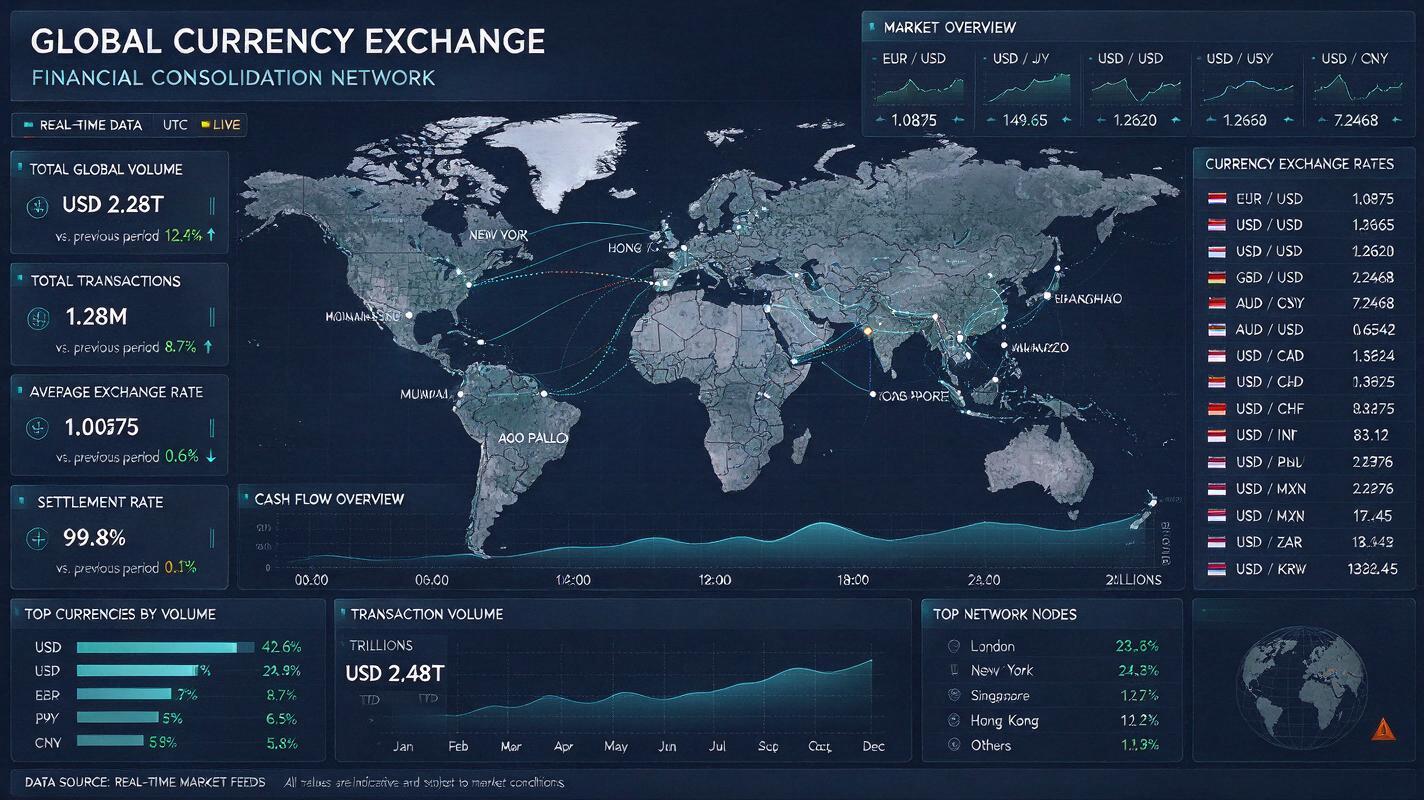
Without an advanced enterprise resource planning architecture, global finance departments become paralyzed by manual spreadsheet conversions. Corporate controllers spend days downloading daily exchange rates from central bank portals, manually calculating realized and unrealized currency gains and losses, and untangling intercompany accounts. During month-end close, reconciling cross-border intercompany balances across fluctuating exchange rates frequently delays financial reporting by weeks.
Modern multi currency erp accounting engines solve these complex computational challenges. By embedding automated exchange rate feeds, dynamic currency revaluation algorithms, and automated intercompany elimination frameworks directly into the transactional database, enterprise software transforms chaotic global accounting into a synchronized, audit-ready operational machine.
This comprehensive guide breaks down the core mechanics of multi-currency ledgers, ASC 830 and IAS 21 currency translation standards, automated revaluation workflows, and global multi-tier corporate consolidations.
Architectural Hierarchy: Transaction, Base, and Reporting Currencies
To understand how an enterprise ERP manages foreign exchange, corporate controllers must understand the structural hierarchy of currency definitions within modern relational database schemas:
1. Transaction Currency:
The transaction currency is the specific currency in which an individual business event occurs. For example, when an operating subsidiary in Germany sells industrial components to a customer in the United Kingdom, the transaction currency is British Pounds (GBP). The original sales order, customer invoice, and customer payment are all captured and stored in GBP, preserving the exact commercial terms negotiated with the client.
2. Base (Functional) Currency:
The base currency—often referred to under US GAAP as the functional currency—is the primary currency of the economic environment in which an individual operating entity generates and expends cash. In our previous example, the German operating subsidiary’s base currency is the Euro (EUR). When the GBP invoice is posted, the ERP financial module automatically retrieves the effective spot exchange rate for that transaction date, recording the transaction in GBP while simultaneously posting corresponding debit and credit entries in EUR to the subsidiary’s local general ledger.
3. Reporting (Consolidation) Currency:
The reporting currency is the centralized currency used by the corporate parent holding entity to present consolidated financial statements to executive leadership, boards of directors, tax authorities, and public capital markets. If the corporate parent is headquartered in New York, the reporting currency is United States Dollars (USD). During consolidated month-end close, the ERP translates the subsidiary’s EUR balance sheet and income statement into USD according to statutory accounting standards.
By maintaining this three-tier data model for every transaction, enterprise systems guarantee complete historical transparency without overwriting original transactional values. To explore financial module foundations, consult our guide to core ERP financial management module capabilities.
Advertisement
Exchange Rate Automation and Dynamic Rate Types
Manual entry of foreign exchange rates is a primary vector for financial reporting errors and operational delays. Enterprise ERP suites eliminate manual data entry through automated integration with certified exchange rate providers (such as Bloomberg, Thomson Reuters, OANDA, XE.com, or central banks like the European Central Bank and Federal Reserve).
Modern financial modules support multiple distinct exchange rate types simultaneously:
– Spot Rates: The real-time or daily closing rate used to record immediate transactions, such as supplier bills, customer invoices, and daily cash disbursements.
– Average Rates: The weighted or arithmetic average exchange rate over a specific accounting period. Under statutory accounting frameworks (ASC 830 and IAS 21), income statement revenues and operating expenses must be translated into the corporate reporting currency using average exchange rates.
– Historical Rates: The specific exchange rate in effect on the date an asset was acquired or equity was issued. Balance sheet equity accounts (such as common stock and additional paid-in capital) and certain fixed assets must be translated using historical rates to prevent artificial distortions in corporate equity.
– Budget / Planning Rates: Static internal exchange rates established by corporate treasury during annual budgeting cycles. Utilizing fixed planning rates allows finance teams to conduct operational variance analysis without currency fluctuations distorting operational department performance.
Realized vs. Unrealized Currency Gains and Losses: Mechanics and Journal Entries
Currency volatility introduces continuous balance sheet fluctuations that must be accounted for according to strict statutory guidelines. Enterprise ERP engines automate the complex calculations distinguishing realized gains and losses from unrealized balance sheet revaluations.
Realized Gain or Loss Mechanics:
A realized gain or loss occurs when a foreign currency monetary transaction is settled and cash physically changes hands.
– Example: A US-based business purchases raw materials from a Japanese supplier on March 1 for 10,000,000 Japanese Yen (JPY), when the exchange rate is 1 USD = 150 JPY. The accounts payable ledger records an obligation of $66,666.67 USD.
– When the invoice is paid on April 15, the exchange rate has shifted to 1 USD = 155 JPY. Settling the 10,000,000 JPY bill now requires only $64,516.13 USD.
– The ERP automatically recognizes a realized foreign exchange gain of $2,150.54 USD, crediting the gain directly to the income statement without manual calculation.
Unrealized Balance Sheet Revaluation:
At the close of each financial accounting period, all open foreign-currency monetary assets and liabilities (such as open accounts receivable, unpaid accounts payable, and foreign bank accounts) must be revalued to reflect current spot rates.
– The ERP revaluation batch job recalculates carrying balances across thousands of open records simultaneously.
– The system generates automated month-end adjusting journal entries to unrealized gain/loss balance sheet reserve accounts.
– Crucially, on the first day of the subsequent accounting period, modern ERP systems execute automated auto-reversing entries, resetting open subledger balances so that standard operations proceed without balance sheet distortions. For banking integration insights, see our analysis of automated bank reconciliation in enterprise ERP.
Multi-Entity Consolidation Architecture and Automated Intercompany Eliminations
The pinnacle of multi-currency financial management is the automated corporate consolidation cycle. In decentralized global enterprises, holding companies frequently operate multi-tiered corporate subsidiary trees: a global parent holding regional holding companies, which in turn hold operational subsidiaries, joint ventures, and distribution entities.
Modern ERP consolidation engines execute comprehensive multi-subsidiary rollups:
1. Cumulative Translation Adjustment (CTA):
When translating foreign subsidiary balance sheets from their functional currencies into corporate reporting currency, discrepancies inevitably arise between assets/liabilities (translated at period-end spot rates) and equity (translated at historical rates). The ERP automatically calculates this translation variance and posts it directly to Accumulated Other Comprehensive Income (AOCI) under the Cumulative Translation Adjustment (CTA) equity line, keeping the consolidated balance sheet in balance.
2. Automated Intercompany Matching and Elimination:
When Subsidiary A in Germany sells inventory to Subsidiary B in the United States, Subsidiary A carries an Accounts Receivable balance while Subsidiary B carries an Accounts Payable balance. On a consolidated corporate balance sheet, a company cannot owe money to itself, nor can it recognize revenue by selling goods to its own corporate entities.
– The ERP financial engine identifies intercompany trading partner tags on transactional ledgers.
– The system automatically executes intercompany elimination journal entries at the consolidation level, wiping out corresponding AR/AP balances, intercompany loans, management fees, and unrealized intercompany inventory markups.
For organizations evaluating enterprise scale, review our comparative breakdown of tier 1 vs tier 2 ERP systems.
Multi-Currency Financial Capabilities Comparison Table
The following analytical matrix summarizes the primary multi-currency capabilities of modern enterprise ERP systems and their operational significance:
| Capability Dimension | Operational Mechanism | Corporate Benefit |
|---|---|---|
| Automated Rate Feeds | API integration with OANDA, Bloomberg, or central banks for daily spot & average rates. | Eliminates manual data entry; guarantees audit compliance and rate consistency. |
| Dynamic Multi-Book | Parallel general ledgers recording transactions under US GAAP and local IFRS rules simultaneously. | Satisfies local statutory filings while maintaining unified corporate reporting. |
| Automated Revaluation | Batch month-end revaluation of open AP/AR and foreign cash accounts with auto-reversing entries. | Accurate period-end balance sheets; prevents erroneous double-counting of FX gains/losses. |
| Intercompany Eliminations | Algorithmic reconciliation and elimination of cross-subsidiary receivables, payables, and markups. | Compresses consolidation cycle from two weeks to under two hours. |
| CTA Equity Management | Automated balance sheet translation balancing via Cumulative Translation Adjustment equity lines. | Ensures compliance with ASC 830 / IAS 21 without manual reconciliation spreadsheets. |
Corporate Treasury and Hedging Integration
Beyond accounting compliance, global currency volatility poses substantial cash flow risks to multinational corporations. Sudden currency devaluations can instantly erase operating margins on overseas sales or dramatically inflate raw material procurement costs.
Modern ERP financial suites integrate directly with corporate treasury management modules:
– Exposure Tracking: The ERP analyzes open sales orders, pending purchase orders, and scheduled accounts receivable collections across all operational currencies. The system generates real-time net currency exposure reports, identifying net long or short positions in specific currencies (e.g., net long EUR, net short JPY).
– Derivative and Hedging Management: When corporate treasury enters forward contracts, currency options, or cross-currency swaps to hedge against foreign exchange volatility, these financial instruments are tracked directly in the ERP. The system links hedge contracts to specific underlying commercial transactions, enforcing hedge accounting compliance (ASC 815 / IFRS 9) and recording mark-to-market fair value adjustments automatically.
To evaluate how revenue streams interact with international contracts, review our analysis of ERP revenue recognition and ASC 606 compliance.
Frequently Asked Questions About Multi-Currency ERP Accounting
What is the difference between a functional currency and a reporting currency?
A functional currency is the primary currency of the economic environment in which a specific operating entity conducts daily business. The reporting currency is the centralized currency used by the corporate parent to present consolidated financial statements to investors and regulators.
How does an ERP handle transactions when daily exchange rates fluctuate?
The ERP records transactions using the specific spot rate active on the transaction date. At month-end, any open unpaid balances are revalued at the closing spot rate, with the difference posted to an unrealized gain or loss account.
Why is automated intercompany elimination critical in multi-currency environments?
Because intercompany transactions involve two legal entities frequently operating in different currencies, manual elimination requires cross-currency reconciliation. Automated ERP elimination identifies matching transaction tags, converts both sides to consolidation currency, and eliminates balances instantly.
What is Cumulative Translation Adjustment (CTA)?
CTA is an equity line item on a consolidated balance sheet under Accumulated Other Comprehensive Income. It captures the mathematical variance resulting from translating foreign subsidiary assets and liabilities at current spot rates while translating equity at historical rates.
Conclusion: Turning Currency Volatility into Strategic Confidence
Operating a global enterprise requires financial systems capable of navigating foreign exchange volatility with mathematical precision and uncompromising regulatory compliance. Legacy spreadsheets and manual exchange rate conversions are fundamentally incapable of supporting modern cross-border commerce.
By deploying an enterprise ERP equipped with automated rate feeds, dynamic multi-book general ledgers, automated month-end revaluations, and algorithmic intercompany eliminations, corporate finance leaders transform global accounting from an administrative bottleneck into an operational advantage.
With real-time visibility into net currency exposures and consolidated balance sheets, your executive team can pursue global market expansion with total financial clarity and audit-ready peace of mind.