
Table of Contents
- Introduction: Procurement as an Engine of Enterprise Margin Protection
- The Complete Procure-to-Pay (P2P) Lifecycle in Enterprise ERP
- Blanket Purchase Agreements, Contract Pricing, and Rebate Capture
- Empirical Supplier Performance Scorecards: Quality, On-Time Delivery, and Price Variance
- Procurement Optimization Comparison Matrix
- Vendor Portal Integration: Collaborative Supply Chain Execution
- Vendor Risk Management, Insurance, and Compliance Tracking
- Frequently Asked Questions About ERP Procurement Workflows
- Conclusion: Strategic Spend Governance for Enterprise Scalability
Introduction: Procurement as an Engine of Enterprise Margin Protection
In an era characterized by global supply chain volatility, raw material inflation, and tight operating margins, corporate procurement has transcended its historical role as a back-office transactional purchasing function. Today, strategic procurement represents one of the most powerful levers an enterprise can pull to protect gross margins, optimize working capital, and guarantee operational continuity.
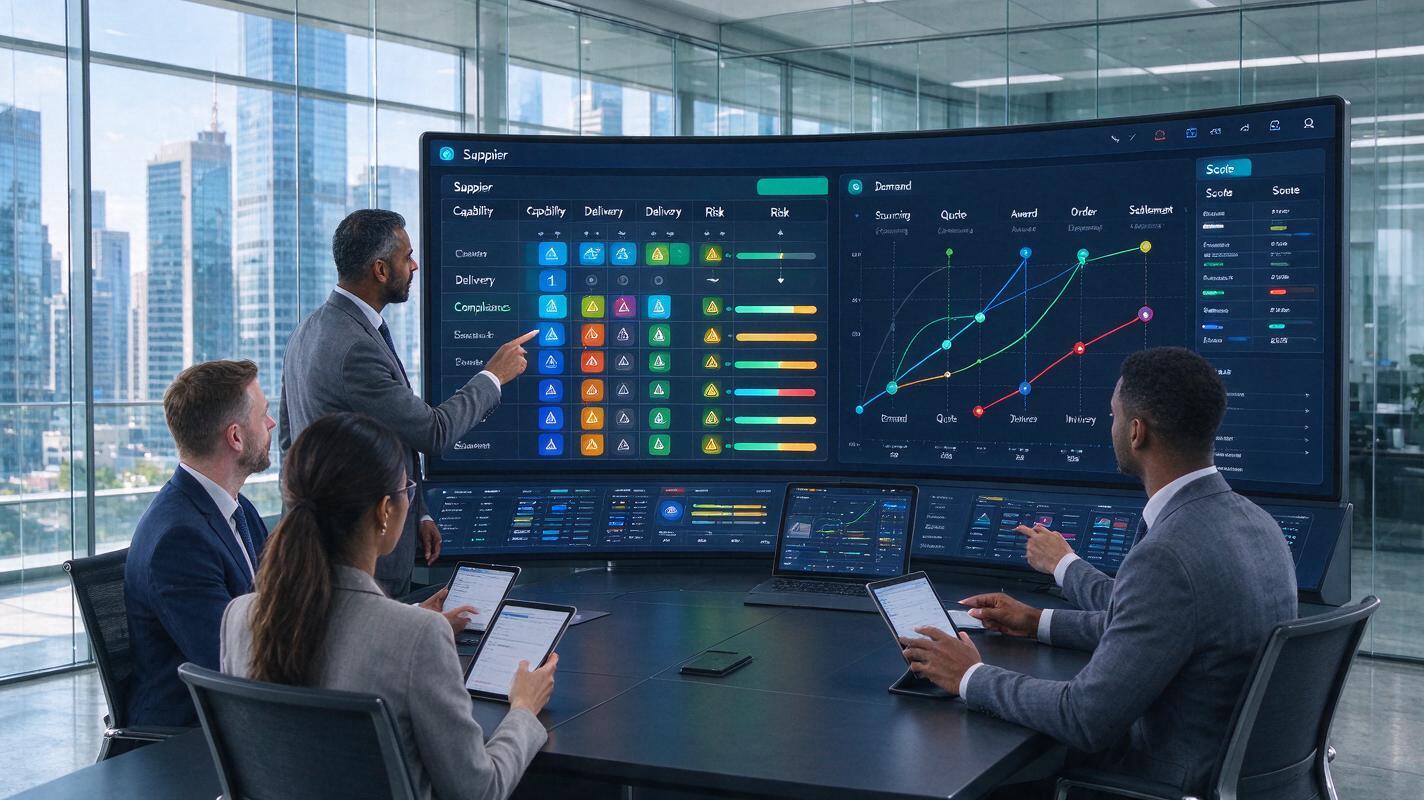
Yet in many organizations, purchasing workflows remain crippled by legacy inefficiencies. Departmental employees purchase supplies on corporate credit cards without pre-approval (maverick spend), purchasing agents draft purchase orders on isolated spreadsheets, and supplier performance is evaluated based on subjective impressions rather than empirical metrics. When supplier deliveries arrive late or quality defects occur, corporate leadership lacks the data to enforce contractual Service Level Agreements (SLAs) or negotiate volume rebates.
Modern erp procurement vendor management workflows transform this unstructured landscape. By integrating employee requisitioning, multi-tiered approval matrices, automated purchase order generation, supplier scorecards, and contract lifecycle management into a unified enterprise platform, modern ERP suites deliver total spend visibility and operational control.
This comprehensive guide analyzes procure-to-pay (P2P) automation, blanket purchase agreements, dynamic supplier performance scorecards, and regulatory vendor risk management.
The Complete Procure-to-Pay (P2P) Lifecycle in Enterprise ERP
The enterprise procure-to-pay lifecycle connects corporate operational requirements directly with external supplier networks:
1. Requisition Intake and PunchOut Catalogs:
Internal departmental users submit purchase requisitions via intuitive self-service portals. For contracted suppliers (such as industrial equipment or office supplies), users leverage cXML PunchOut catalogs, browsing supplier e-commerce portals while the ERP captures negotiated contracted pricing and returns line items directly into an internal draft requisition.
2. Dynamic Approval Hierarchies:
Requisitions are automatically evaluated by rule-based routing engines:
– Spend Limits: Requisitions under $5,000 auto-route to direct supervisors; requisitions over $50,000 escalate to VP or CFO sign-off.
– Budgetary Validation: The ERP checks active departmental general ledger budgets. If a requisition causes a department to exceed its quarterly operating budget, the system triggers a budget variance approval workflow or halts the transaction.
3. Automated Purchase Order (PO) Conversion and Transmission:
Upon final sign-off, the ERP automatically converts the approved requisition into a formal legal Purchase Order. The PO is dispatched electronically to the vendor via EDI (EDI 850), secure API, or automated interactive email. For accounts payable integration, review our guide to automated accounts payable ERP workflows.
Blanket Purchase Agreements, Contract Pricing, and Rebate Capture
In high-volume manufacturing and wholesale distribution, negotiating pricing on an ad-hoc purchase-by-purchase basis is inefficient. Enterprises leverage Blanket Purchase Agreements (BPAs) and Contract Purchase Orders to lock in favorable volume pricing over annual horizons.
Modern ERP procurement modules manage contract nuances natively:
– Tiered Volume Pricing: Automatically applies discounted price breaks when cumulative order quantities reach pre-negotiated thresholds (e.g., $10.00/unit for 1,000 units, dropping to $8.50/unit once cumulative purchases exceed 10,000 units annually).
– Automated Release Orders: When manufacturing schedules or inventory reorder points trigger replenishment, the ERP generates call-off release orders against the master blanket contract without requiring renegotiation.
– Vendor Rebate Accounting: Tracks retroactive volume rebates owed by suppliers. If an agreement stipulates a 3% rebate upon spending $1 million annually, the ERP monitors spend accruals, flags milestone achievement, and generates automated debit memos to collect earned rebates. For inventory optimization, see our guide on enterprise ERP inventory management best practices.
Empirical Supplier Performance Scorecards: Quality, On-Time Delivery, and Price Variance
Subjective vendor reviews breed supplier complacency. Modern ERP suites automatically evaluate suppliers using empirical transaction data across three critical key performance indicators:
Advertisement
1. On-Time, In-Full (OTIF) Delivery Metrics:
The ERP compares the supplier’s promised delivery date on the PO confirmation against the actual physical dock receiving timestamp:
– Did the shipment arrive early, on time, or late?
– Were delivered quantities 100% complete, or did the supplier ship a partial order?
The system calculates rolling OTIF percentage scores for every active vendor.
2. Quality Defect and RMA Tracking:
When receiving docks or quality control inspectors reject defective materials, the ERP logs a Non-Conformance Report (NCR) and Return Merchandise Authorization (RMA). The system calculates vendor defect rates in Parts Per Million (PPM), directly impacting supplier tier ratings.
3. Purchase Price Variance (PPV):
The ERP compares invoiced unit prices against standard purchase price baselines, identifying suppliers that systematically introduce unexpected surcharges or price creep.
Suppliers falling below target performance thresholds are automatically restricted from receiving new purchase orders until corrective action plans are approved. To evaluate supply chain tracking, explore our guide on real-time supply chain visibility in ERP.
Procurement Optimization Comparison Matrix
The following analytical matrix compares traditional decentralized purchasing against modern automated ERP procurement workflows:
| Procurement Dimension | Decentralized Purchasing (Manual) | Automated ERP Procurement Workflow |
|---|---|---|
| Maverick / Off-Contract Spend | High (20-35% of total corporate expenditure). | Virtually eliminated (< 2% enforced via catalogs). |
| Requisition-to-PO Cycle Time | 5 to 9 business days (email chasing). | Under 4 hours (automated mobile routing). |
| Supplier Evaluation Rigor | Subjective, anecdotal impressions. | Algorithmic OTIF, PPM quality, and PPV scorecards. |
| Contract Compliance | Contracts stored in PDFs; pricing rarely audited. | Enforced blanket pricing and automated rebate tracking. |
| Audit Trail Transparency | Fragmented paper trails and lost email threads. | Immutable digital history linking requisition to payment. |
Vendor Portal Integration: Collaborative Supply Chain Execution
Modern ERP suites eliminate friction through collaborative Supplier Self-Service Portals. Rather than relying on phone calls and emails to confirm delivery dates, suppliers access a dedicated, secure web portal:
– Interactive PO Acknowledgement: Vendors view issued purchase orders, confirm acceptance, or propose revised delivery dates directly within the portal.
– Advanced Shipping Notices (ASN): Suppliers submit ASNs prior to freight dispatch, detailing carton barcodes, carrier tracking numbers, and container packing slips. Receiving docks ingest ASNs to pre-plan labor and dock door allocations.
– Electronic Invoicing and Payment Status: Vendors upload digital invoices and track real-time payment disbursement schedules, drastically reducing inbound inquiry phone calls to corporate AP teams.
For multi-tier system scalability, explore our comparative analysis of tier 1 vs tier 2 ERP systems.
Vendor Risk Management, Insurance, and Compliance Tracking
Managing corporate third-party risk is an essential governance duty. When suppliers fail to maintain required liability insurance or violate statutory labor standards, the purchasing enterprise faces severe legal liability.
ERP vendor management modules enforce strict compliance controls:
– Certificate of Insurance (COI) Expiration Tracking: Tracks vendor commercial liability and worker’s compensation insurance policies. If a COI expires, the ERP automatically flags the vendor and prevents issuance of new POs.
– Sanctions and Anti-Bribery Screening: Cross-references vendor profiles against global government sanctions databases (such as OFAC and PEP lists) to prevent regulatory violations.
– Conflict Minerals and ESG Compliance: Tracks supplier documentation verifying environmental, social, and governance (ESG) compliance, ensuring ethical sourcing standards.
Frequently Asked Questions About ERP Procurement Workflows
What is maverick spend and how does ERP prevent it?
Maverick spend refers to unauthorized purchases made outside contracted vendor agreements. ERP prevents it by requiring digital purchase requisitions routed through pre-approved catalog pricing and multi-tiered manager approval matrices.
What is the difference between a Purchase Requisition and a Purchase Order?
A Purchase Requisition is an internal departmental request to purchase goods or services. Once approved and validated against corporate budgets, the ERP converts it into a formal legal Purchase Order dispatched to the external vendor.
How does an ERP calculate OTIF supplier scores?
On-Time, In-Full (OTIF) compares promised delivery dates and ordered quantities against physical warehouse receiving dock timestamps and quantities, calculating a percentage score of perfect deliveries.
What is a PunchOut catalog in enterprise procurement?
A PunchOut catalog allows corporate users to leave the ERP interface, shop on a vendor’s authorized e-commerce website with contracted corporate pricing, and transfer the selected items back into an ERP draft requisition with a single click.
Furthermore, enterprise organizations must implement disciplined governance controls across software evaluation frameworks. By establishing clear cross-departmental accountability, continuous stakeholder alignment, and structured change management protocols, corporate leadership ensures that technological investments directly advance broader operational objectives. This strategic alignment mitigates implementation friction, protects capital allocation, and maximizes measurable business outcomes throughout the entire organizational lifecycle.
In addition, modern cloud enterprise architectures require ongoing optimization to maintain peak performance as transaction volumes expand. Cross-functional committees should conduct periodic architectural reviews, evaluate emerging integration capabilities, and refine role-based security configurations. Maintaining this proactive operational posture ensures sustained scalability, regulatory compliance, and enduring competitive advantage across evolving market sectors.
Moreover, establishing standardized performance telemetry allows enterprise operations teams to detect systemic bottlenecks before they impact customer fulfillment. Continuous data analysis reveals opportunities for incremental process automation, supplier SLA enforcement, and working capital optimization, ensuring that technology investments compound in value over time.
Finally, the convergence of automated workflow orchestration and real-time business intelligence creates an agile foundation for future market expansion. Organizations that cultivate deep digital fluency across operational departments achieve superior customer satisfaction scores, lower operating overhead, and greater strategic agility in volatile economic conditions.
To sustain continuous operational excellence, executive leadership must sponsor ongoing knowledge transfer initiatives that empower frontline users to leverage advanced system analytics. Cultivating internal centers of excellence ensures that best practices permeate all operating units, reducing dependence on external consultants and embedding organizational resilience into corporate culture.
Ultimately, successful enterprise digital transformation is defined not by the technology itself, but by an organization’s capacity to translate data clarity into decisive commercial execution. By continually refining procedural governance, investing in human adoption, and adhering to architectural rigor, forward-thinking enterprises establish enduring operational leadership in today’s dynamic global marketplace.
Conclusion: Strategic Spend Governance for Enterprise Scalability
Procurement is no longer a clerical function; it is a strategic driver of enterprise profitability and supply chain resilience. Continuing to manage vendor relationships and purchase orders through fragmented manual processes leaves millions of dollars in uncaptured savings on the table while exposing the enterprise to operational disruptions.
By deploying automated procurement and vendor management workflows within an enterprise ERP, organizations establish total spend visibility, eliminate rogue purchasing, and hold suppliers accountable with empirical performance scorecards.
Empowering your procurement team with automated tools and real-time operational data protects your balance sheet, strengthens vendor partnerships, and builds an enduring operational foundation for scalable commercial success.
Furthermore, enterprise organizations must implement disciplined governance controls across software evaluation frameworks. By establishing clear cross-departmental accountability, continuous stakeholder alignment, and structured change management protocols, corporate leadership ensures that technological investments directly advance broader operational objectives. This strategic alignment mitigates implementation friction, protects capital allocation, and maximizes measurable business outcomes throughout the entire organizational lifecycle.
In addition, modern cloud enterprise architectures require ongoing optimization to maintain peak performance as transaction volumes expand. Cross-functional committees should conduct periodic architectural reviews, evaluate emerging integration capabilities, and refine role-based security configurations. Maintaining this proactive operational posture ensures sustained scalability, regulatory compliance, and enduring competitive advantage across evolving market sectors.
Moreover, establishing standardized performance telemetry allows enterprise operations teams to detect systemic bottlenecks before they impact customer fulfillment. Continuous data analysis reveals opportunities for incremental process automation, supplier SLA enforcement, and working capital optimization, ensuring that technology investments compound in value over time.
Finally, the convergence of automated workflow orchestration and real-time business intelligence creates an agile foundation for future market expansion. Organizations that cultivate deep digital fluency across operational departments achieve superior customer satisfaction scores, lower operating overhead, and greater strategic agility in volatile economic conditions.